DLAB
Design & Digital Fabrication Lab (DLAB) American University of Bahrain
Design & Digital Fabrication Lab (DLAB) at the American University of Bahrain is a hands-on innovation facility where ideas become physical reality. DLAB enables students to design, prototype, test, and refine solutions using advanced digital fabrication technologies within a structured academic environment. The lab supports coursework, capstone projects, research, and interdisciplinary collaboration by providing access to professional equipment, technical expertise, and guided training. DLAB bridges theory and practice, empowering students to move beyond concepts and produce functional, real-world outcomes.
Vision
To be Bahrain’s premier hub where design thinking, creative technologies, and maker culture converge, empowering people to imagine, prototype, and build solutions that serve the nation and improve lives.
Mission
DLAB empowers a new generation of creators through a human-centered approach that identifies real needs and shapes meaningful solutions. Through a hands-on, inclusive, and collaborative ecosystem, we equip students, faculty, and partners with the tools, expertise, and mentorship needed to innovate, build, and grow. At its core, DLAB is a community that advances learning through making, and leadership through doing, while embedding design thinking and creative problem-solving as core practices in our culture.
Key Equipment & Capabilities
DLAB is equipped with a range of professional and educational fabrication tools that support design, prototyping, and small-scale manufacturing processes.
Core equipment includes:
- 3D Printing Technologies
- FDM (Fused Deposition Modeling) printers for rapid prototyping
- SLA / MJP printers for high-resolution and precision components
- Full-color 3D printing for visual models and presentation prototypes
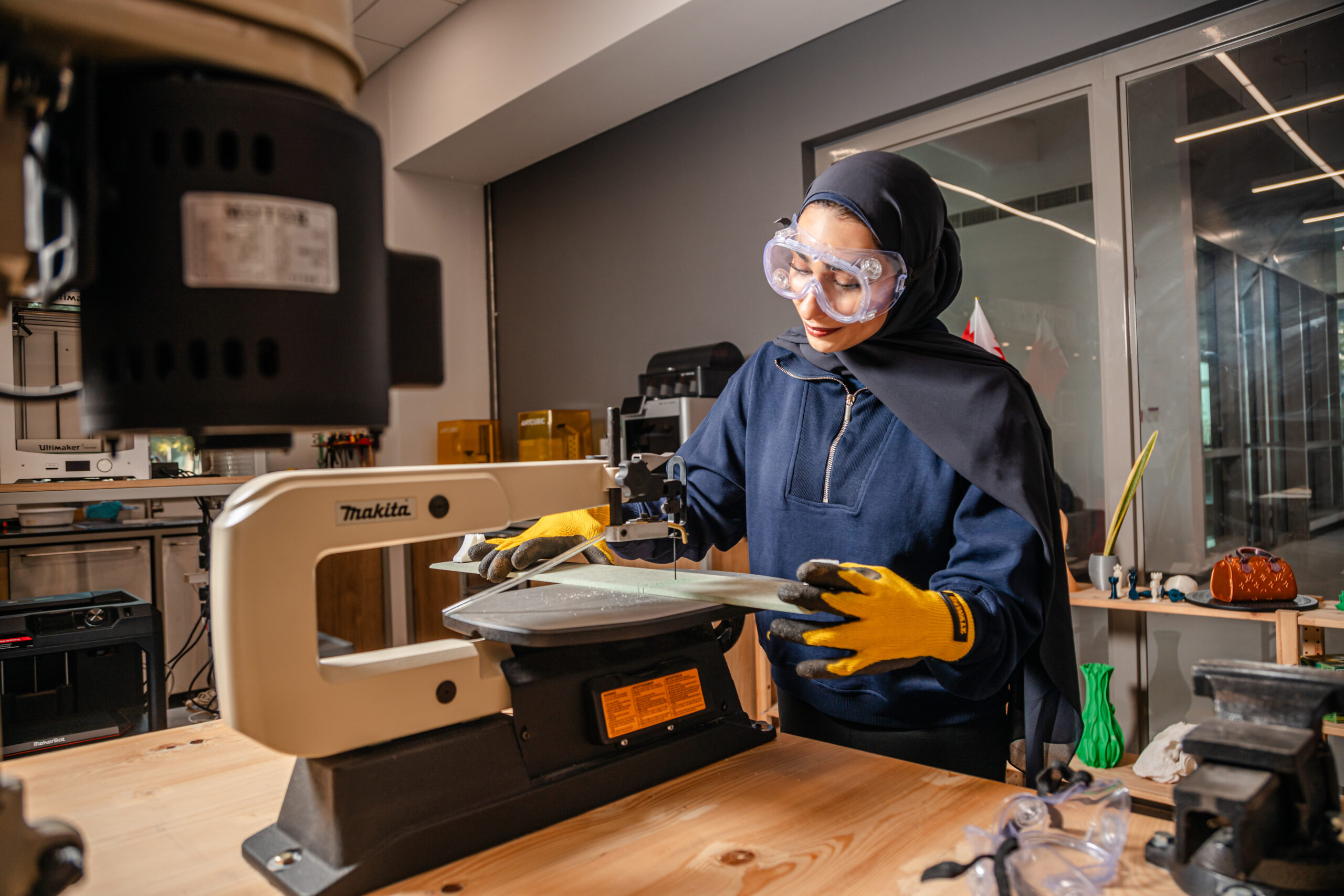
- Laser Cutting Machines for precision cutting and engraving for wood, acrylic, cardboard, and selected plastics
- A number of 3D Scanning & Reverse Engineering tools.
- Professional handheld and desktop scanners for capturing physical geometries and converting them into digital models
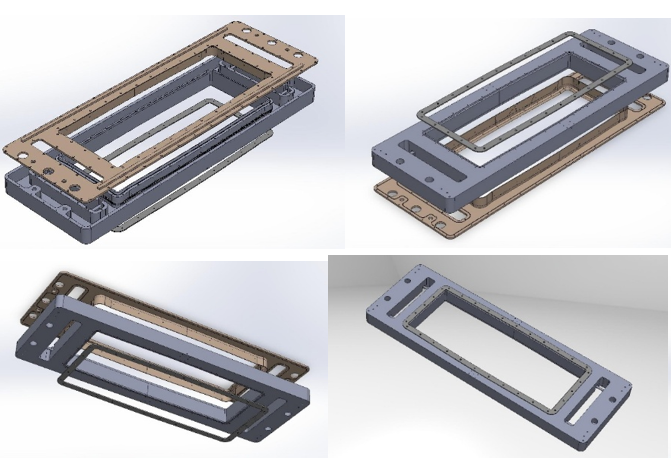
- Vacuum Forming
Our Major Events
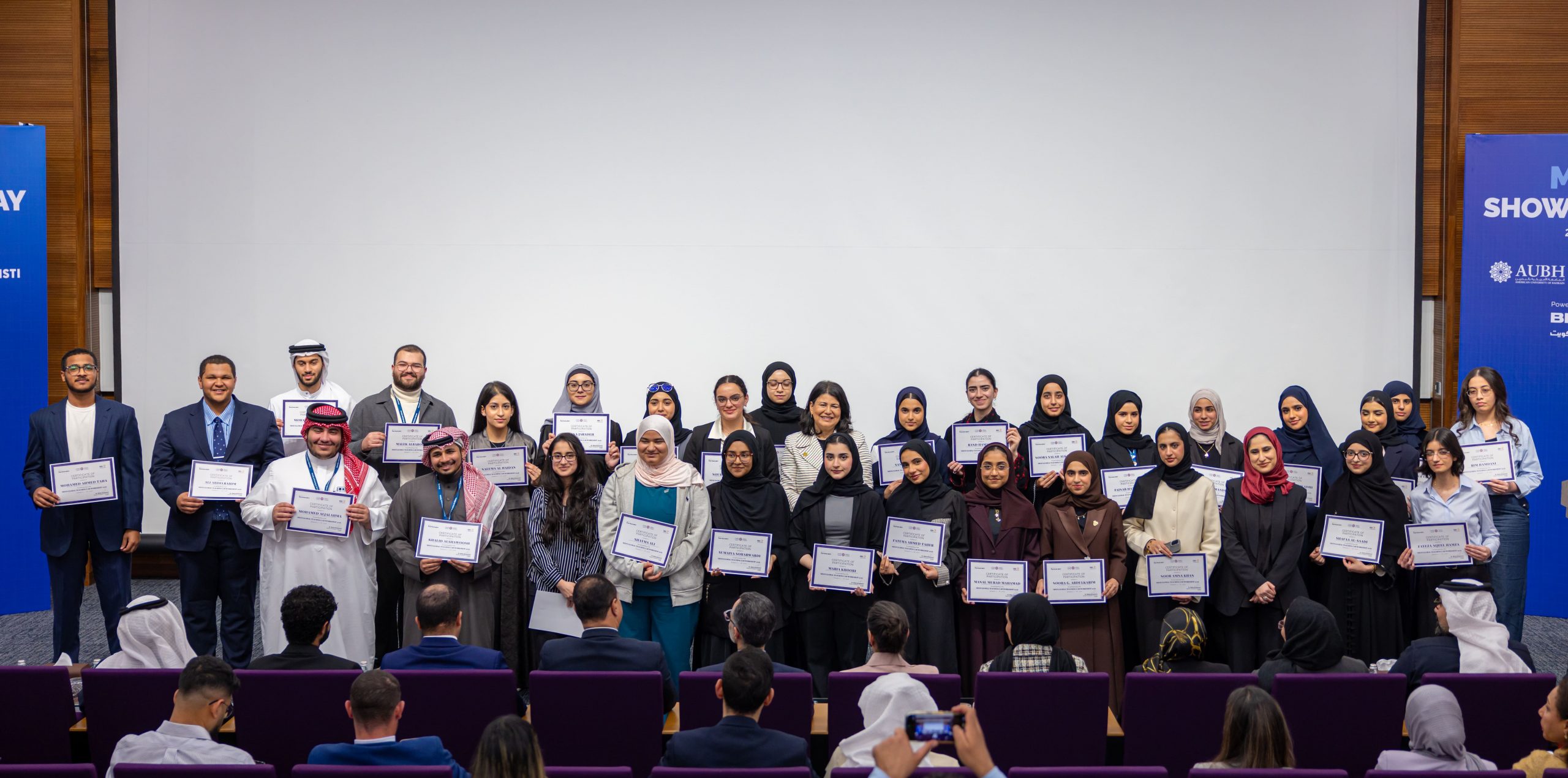
MSITI 2023
Theme: MIT–MISTI Global Teaching Lab (GTL): Transformable Robotics
MSITI 2023 marked the launch of MIT–MISTI activities in Bahrain through the Global Teaching Lab (GTL) initiative. The program focused on transformable robotics, introducing Bahraini high school and university students to MIT-level, hands-on STEM education. The initiative emphasized digital fabrication, electronics, programming, and multidisciplinary design, aligned with MIT’s experiential learning philosophy.
Duration: January 2023 (4 weeks)
Two tracks
- University students (including AUBH students)
- Delivered by MIT undergraduate & graduate instructors with guest lectures from MIT/Harvard faculty and researchers
Key focus areas:
- CAD and digital modeling
- Rapid prototyping (3D printing, laser cutting)
- Arduino programming, sensors, actuators, and circuits
- Lightweight and transformable robotic systems
- Smart geometries and responsive materials
Projects & learning outcomes:
- Transformable robotic artifacts
- Assistive technology concepts, wearables, grippers, and interactive devices
- Team-based final projects synthesizing design, fabrication, and programming
Strategic impact:
- Established AUBH as a host hub for MIT Global Teaching Labs in Bahrain
- Built early MIT–Bahrain academic and research networks
- Introduced students to global lab teaching and multidisciplinary STEM practice
MSITI 2023
Theme: MIT–MISTI Global Teaching Lab (GTL): Transformable Robotics
MSITI 2023 marked the launch of MIT–MISTI activities in Bahrain through the Global Teaching Lab (GTL) initiative. The program focused on transformable robotics, introducing Bahraini high school and university students to MIT-level, hands-on STEM education. The initiative emphasized digital fabrication, electronics, programming, and multidisciplinary design, aligned with MIT’s experiential learning philosophy.
Duration: January 2023 (4 weeks)
Two tracks
- University students (including AUBH students)
- Delivered by MIT undergraduate & graduate instructors with guest lectures from MIT/Harvard faculty and researchers
Key focus areas:
- CAD and digital modeling
- Rapid prototyping (3D printing, laser cutting)
- Arduino programming, sensors, actuators, and circuits
- Lightweight and transformable robotic systems
- Smart geometries and responsive materials
Projects & learning outcomes:
- Transformable robotic artifacts
- Assistive technology concepts, wearables, grippers, and interactive devices
- Team-based final projects synthesizing design, fabrication, and programming
Strategic impact:
- Established AUBH as a host hub for MIT Global Teaching Labs in Bahrain
- Built early MIT–Bahrain academic and research networks
- Introduced students to global lab teaching and multidisciplinary STEM practice
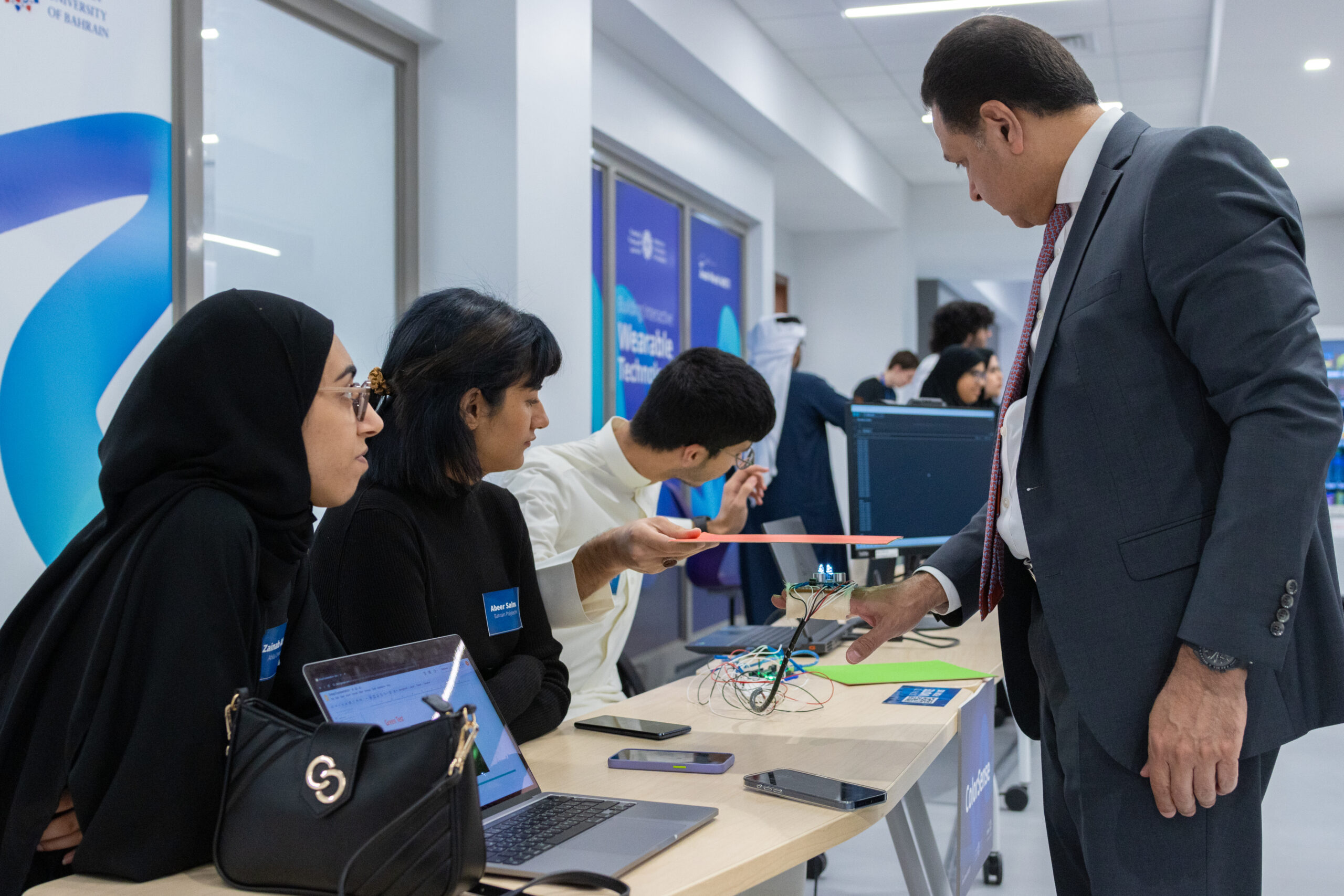
MSITI 2024
Key focus areas:
- Wearable and assistive technologies
- Sensors, microcontrollers, and interactivity
- Smart textiles and human–technology interaction
Projects showcased:
- Wearable assistive devices
- Interactive garments and accessories
- Safety and accessibility-focused wearable solutions
Impact:
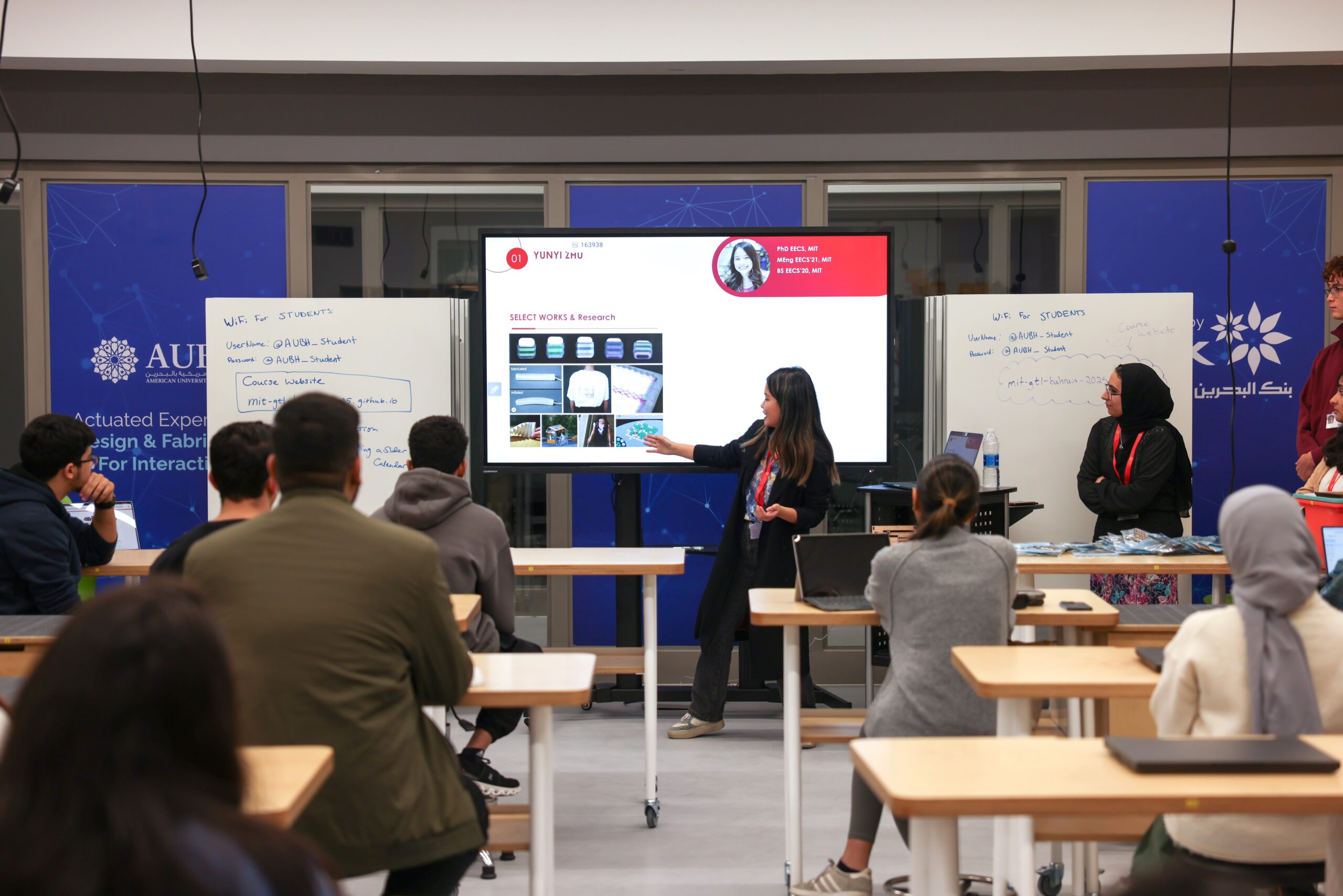
MSITI 2025
- Building Interactive Wearable Technology from Scratch
- Actuated Experiences – Design & Fabrication for Interactivity
Key focus areas:
- Startup ideation and business acceleration
- Interactive and actuated systems
- Advanced design and fabrication
Projects showcased:
- Startup concepts and business pitches
- Interactive installations and devices
- Fabrication-driven, experience-based projects
Impact:
for more information about MISTI please check this link
MISTI Workshops – American University of Bahrain | AUBH
MSITI 2025
- Building Interactive Wearable Technology from Scratch
- Actuated Experiences – Design & Fabrication for Interactivity
Key focus areas:
- Startup ideation and business acceleration
- Interactive and actuated systems
- Advanced design and fabrication
Projects showcased:
- Startup concepts and business pitches
- Interactive installations and devices
- Fabrication-driven, experience-based projects
Impact:
for more information about MISTI please check this link
MISTI Workshops – American University of Bahrain | AUBH
ACTIVITIES, WORKSHOPS & STUDENTS' PROJECTS
Engineering (Mechanical, Electrical, Civil)
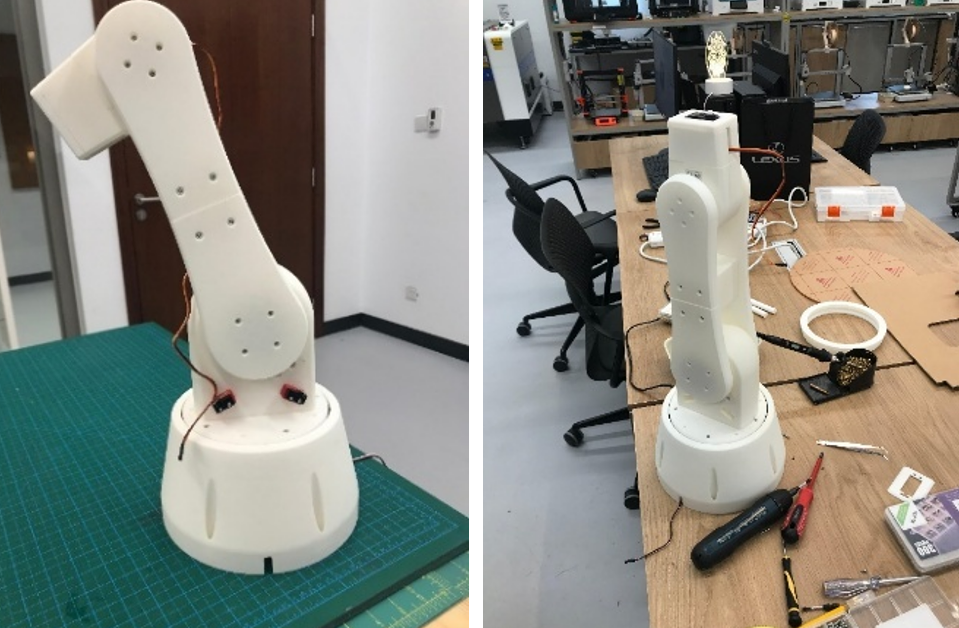
Three Degree of Freedom Robotic Arm
A three-degree-of-freedom robotic arm inspired by the Mitsubishi RV-2AJ, designed and assembled entirely at the AUBH Design and 3D Printing Lab (DLAB). The system incorporates two limit switches to control forward and backward motion and uses high-torque metal-geared servo motors. Built-in 3D-printed bearings enhance smooth operation.
The complete design was developed using SOLIDWORKS, and all white components were 3D printed in PLA+ to reduce prototyping costs using Bambu Lab A1 and X1 Carbon (X1C) printers.
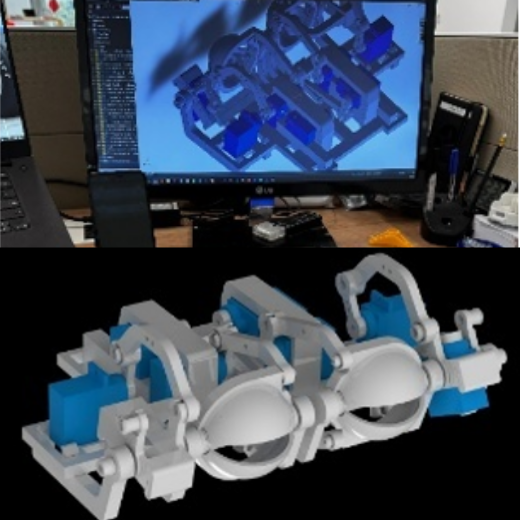
Animatronic Eye Mechanism for Medical Education
This project was developed to support medical education by helping students understand eye movement and its role in identifying stroke-related signals. An existing animatronic eye mechanism was reverse engineered and redesigned to create a joystick-controlled system for interactive teaching and assessment.
The design was created in SOLIDWORKS, and all components were 3D printed in PLA+ using Bambu Lab A1 and X1C printers.
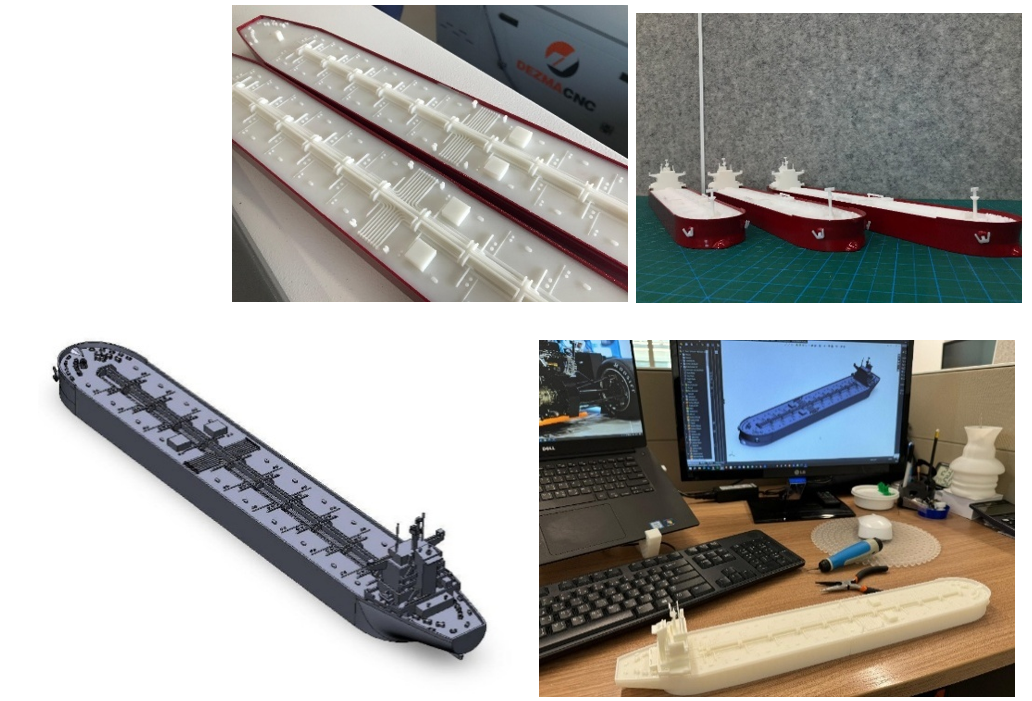
Oil-Carrying Ship Miniature
An oil-carrying ship used by a crude oil company was reverse engineered and recreated as three detailed miniature models for display in their command center. The models were designed in SOLIDWORKS and 3D printed in PLA+ using Bambu Lab A1 and X1C printers.
Architecture & Interior Design
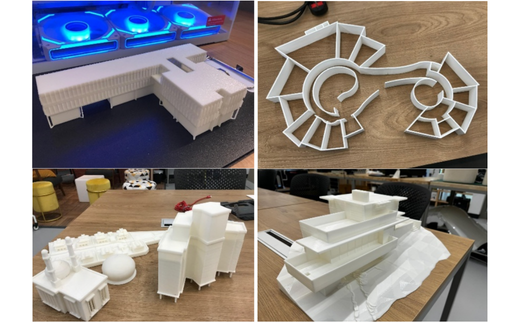
Architectural Miniatures
A collection of miniature building models designed by architecture students and professionals for final-year presentations. These models were produced at AUBH-DLAB using PLA+ filament to ensure cost-effective prototyping and were 3D printed using Bambu Lab A1 and X1C printers.
Product Design and Development and testing
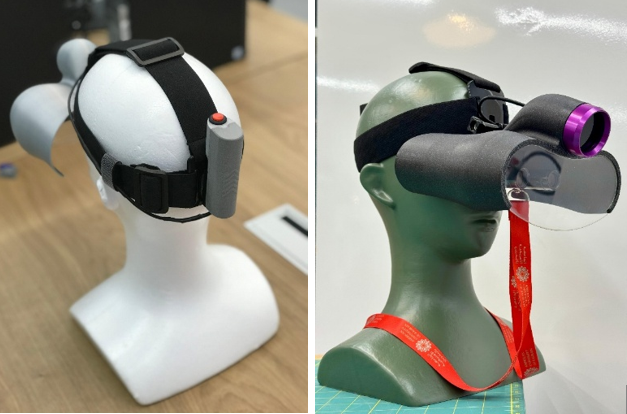
Metal Surface Crack Detection Apparatus
A functional prototype developed for non-destructive testing during aircraft body inspections to detect surface cracks. The device addresses a key challenge faced by inspection engineers by enabling hands-free operation, reducing fatigue, inspection time, and human error while improving accuracy and work quality.
The system was designed in SOLIDWORKS and fabricated using PLA+ on Bambu Lab A1 and X1C 3D printers.
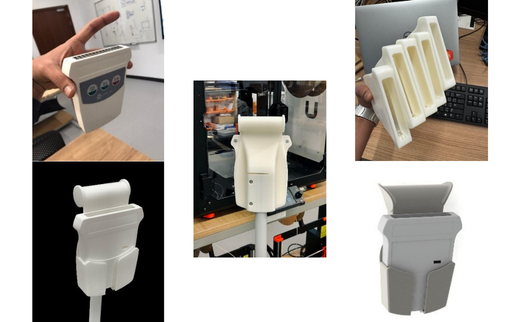
GE MAC 5500 ECG Machine Remote – Design Improvement
To resolve a recurring issue of broken ECG remote enclosures, AUBH-DLAB redesigned and 3D printed a durable replacement housing. The original remote was reverse engineered to ensure precise fitment of internal electronics. After prototyping, testing, and incorporating hospital feedback, multiple finalized enclosures were delivered for operational use.
The design was developed in SOLIDWORKS and 3D printed in PLA+ using Bambu Lab A1 and X1C printers.
Specialized training workshops
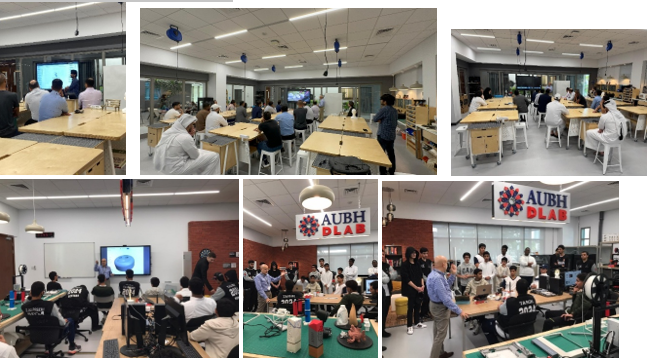
3D Modeling, 3D Printing & Reverse Engineering Workshops
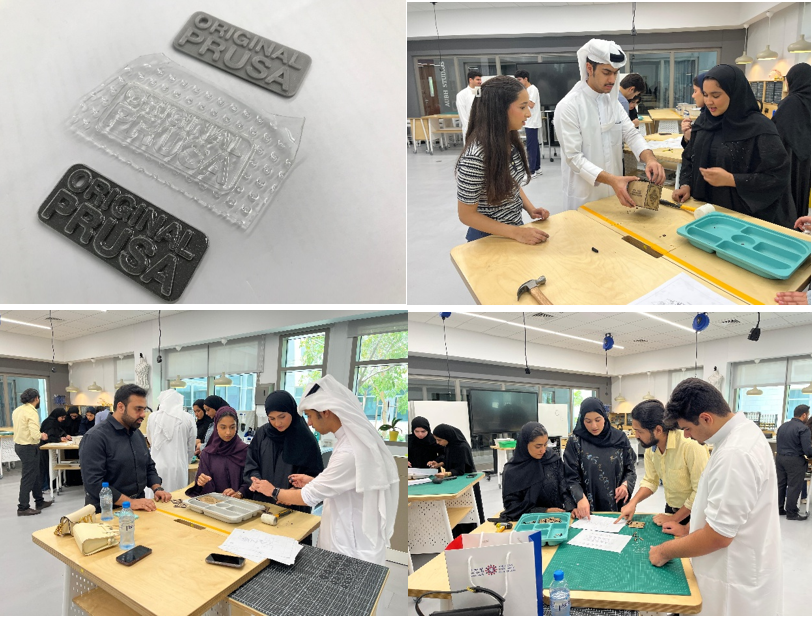
AUBH-DLAB and Project Space host regular hands-on workshops throughout the year focused on 3D modeling, 3D printing, reverse engineering, and 3D scanning. These sessions emphasize experiential learning and practical skill development. The images capture highlights from these workshops.
Multimedia & Design
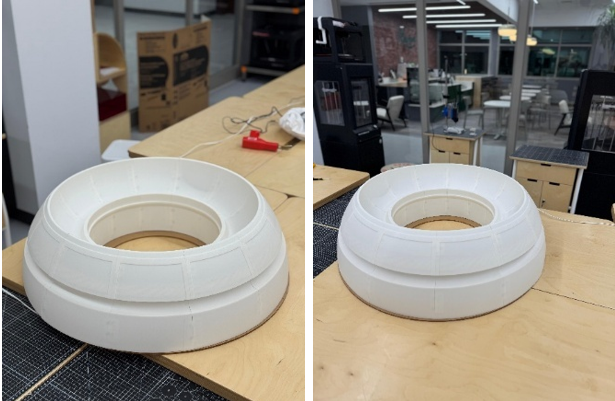
Advertising Prop for an Ad Shoot
A large-scale space- and AI-themed prop designed and manufactured for a commercial advertisement. Due to tight timelines, the object was modularly designed to allow multiple identical prints to be assembled efficiently.
The prop was designed in SOLIDWORKS and fabricated in PLA+ using Bambu Lab A1 and X1C printers. It was featured in an STC advertisement available on YouTube.
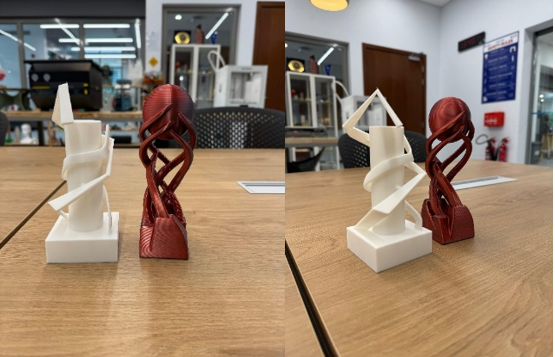
Impossible Trophies
First-year multimedia students were challenged to design and 3D print unique trophies. With minimal prior design experience, students were introduced to workflows involving hand sketches, ChatGPT, and image-to-3D AI tools to create digital models, which were then fabricated using Bambu Lab A1 and X1C printers.
Industrial Manufacturing Design
Oil & Gas Plant and SKID Reverse Engineering
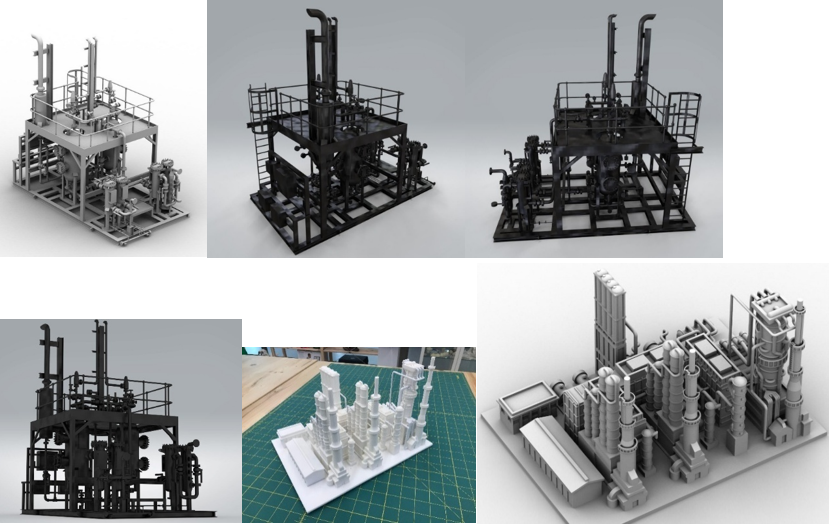
As part of an industrial design course, students were assigned to reverse engineer complex oil and gas plant and SKID systems using SOLIDWORKS. This exercise enabled students to explore real-world industrial layouts, mechanical complexity, and system integration. Selected student works are shown above.
Art & Fashion Design
Human Rib Skeleton Fashion Accessory
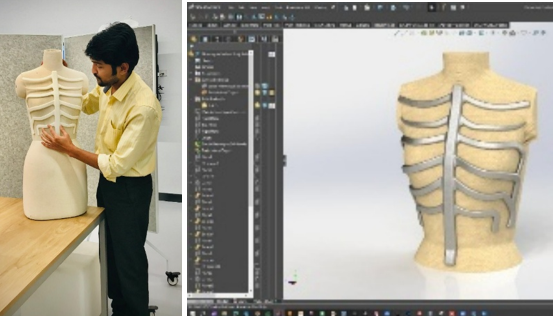
A collaborative capstone project with a final-year fashion design student from a neighboring university. The project involved designing and 3D printing a ribcage-inspired fashion accessory for a mannequin.
Starting from an aluminum-foil prototype, the design was refined and modeled in SOLIDWORKS, demonstrating the adaptability of engineering CAD tools for fashion applications. The final output was produced using the Bambu Lab X1 Carbon, showcasing how FDM 3D printing can support creative industries through rapid prototyping and high-quality fabrication.
Medical Students and Practitioners
GE MAC 5500 ECG Machine Remote – Design Improvement
To resolve a recurring issue of broken ECG remote enclosures, AUBH-DLAB redesigned and 3D printed a durable replacement housing. The original remote was reverse engineered to ensure precise fitment of internal electronics. After prototyping, testing, and incorporating hospital feedback, multiple finalized enclosures were delivered for operational use.
The design was developed in SOLIDWORKS and 3D printed in PLA+ using Bambu Lab A1 and X1C printers.
X-Ray Collimator Front Panel Cover (FRU)
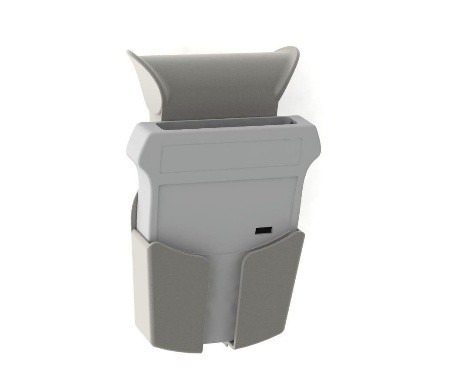
The broken front panel cover handles of an X-ray collimator were reverse engineered and redesigned to securely hold the panel without compromising device accuracy. The solution was modeled in SOLIDWORKS and 3D printed in PLA+ using Bambu Lab A1 and X1C printers.
Medical Test Tube Tray Lock – Design & Assembly
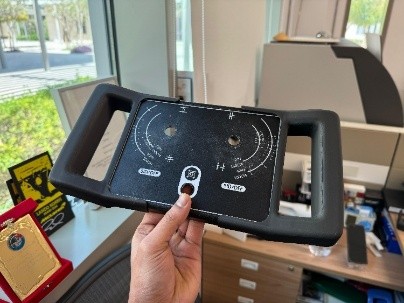
A broken medical test tube tray locking mechanism was reverse engineered and redesigned to ensure secure positioning of the tray while maintaining device precision. The solution was designed in SOLIDWORKS and fabricated in PLA+ using Bambu Lab A1 and X1C printers.
Entrepreneurship and Innovation-focused courses
Foldable Work Desk (INJAZ Competition)
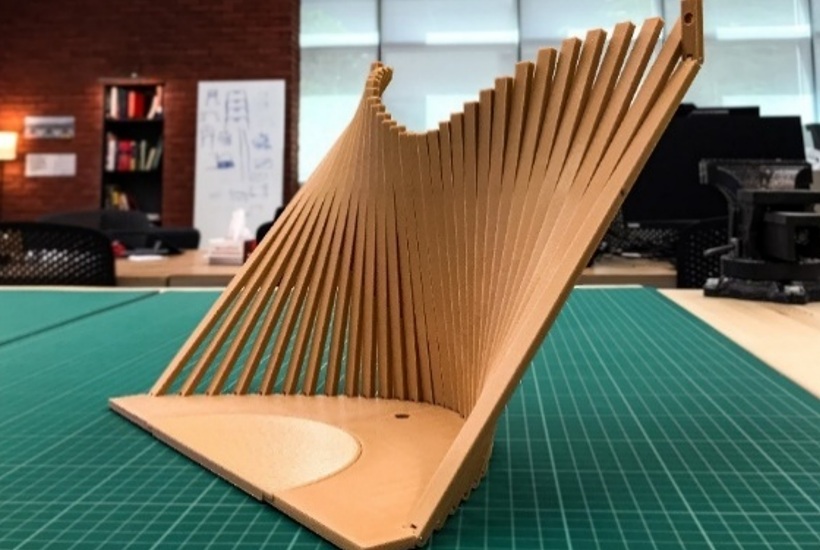
For the INJAZ Bahrain Business Competition, students from the Royal University for Women collaborated with AUBH-DLAB to design and 3D print a scaled prototype of a foldable work desk. The miniature model allowed easy transport and presentation while accurately representing the full-scale product. Designed in SOLIDWORKS and printed in PLA+.
Rethink Sustainable Pens
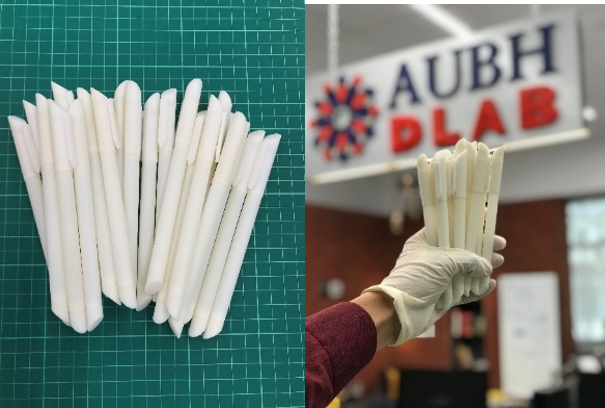
Rethink, a student team led by AUBH students, designed a sustainable pen whose body and cap were 3D printed at AUBH-DLAB. The product was designed in SOLIDWORKS and fabricated using PLA+ filament.
FARZ AI-Powered Garbage Sorting Machine
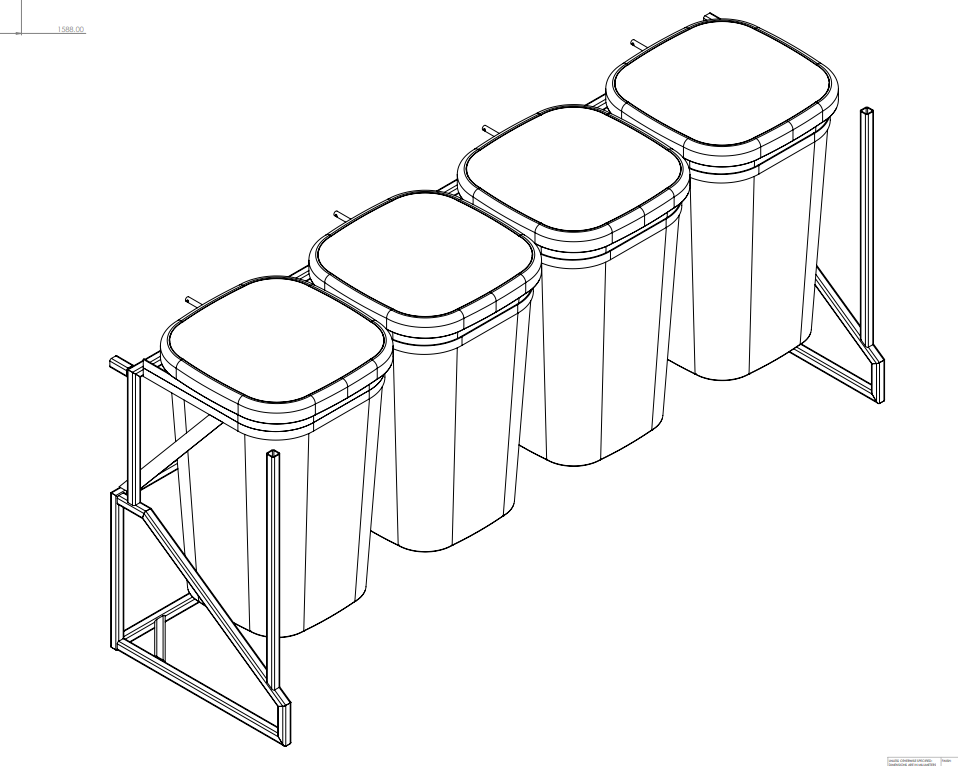
FARZ is a student-led project that resulted in a functional AI-powered garbage sorting machine using computer vision. The team received design, prototyping, and fabrication support from AUBH-DLAB for the INJAZ Bahrain competition. All components were designed in SOLIDWORKS and 3D printed in PLA+.
Capstone and interdisciplinary project teams
Coffee Bean Sorter Machine
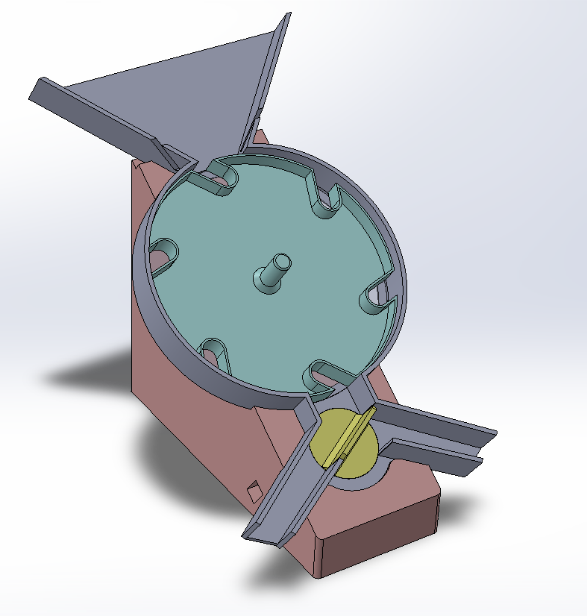
Developed for AUBH Engineering Day, this prototype coffee bean sorting machine was fully designed and assembled at AUBH-DLAB. The system uses a stepper-motor-driven rotating disc that feeds beans one at a time from an open hopper.
A color sensor identifies roasting levels, and an Arduino-controlled servo mechanism directs beans into appropriate channels based on sensor data.
Riffa Clock Tower Miniature
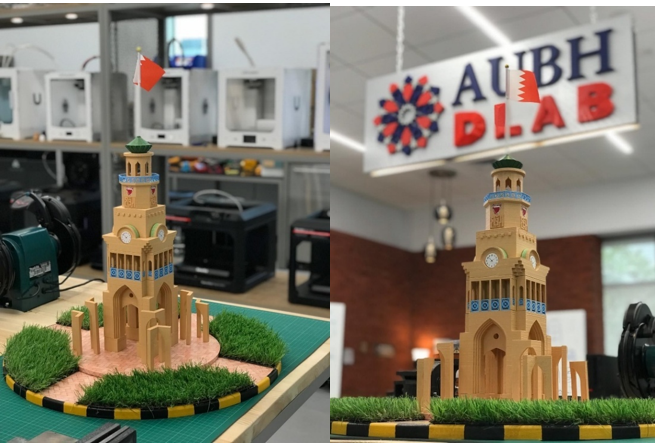
A scaled model of the iconic Riffa Clock Tower Roundabout, designed using Blender and 3D printed in warm gray PLA. To improve print quality and efficiency, the original single model was divided into ten separate parts, significantly reducing material usage and print time.
Examples of projects developed in the DLAB
Engineering prototypes and functional mechanisms
Prosthetic Leg Prototype
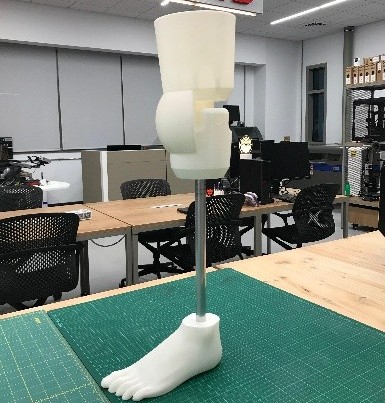
This prosthetic leg prototype was designed and 3D printed at AUBH-DLAB for a school project aimed at simulating the knee joint motion of a human leg. The model was developed using SOLIDWORKS and fabricated using PLA+ to reduce prototyping costs. All components were produced using Bambu Lab A1 and X1 Carbon (X1C) 3D printers.
FARZ AI-Powered Automatic Garbage Sorting Machine – Stepper Motor Bracket and Bucket
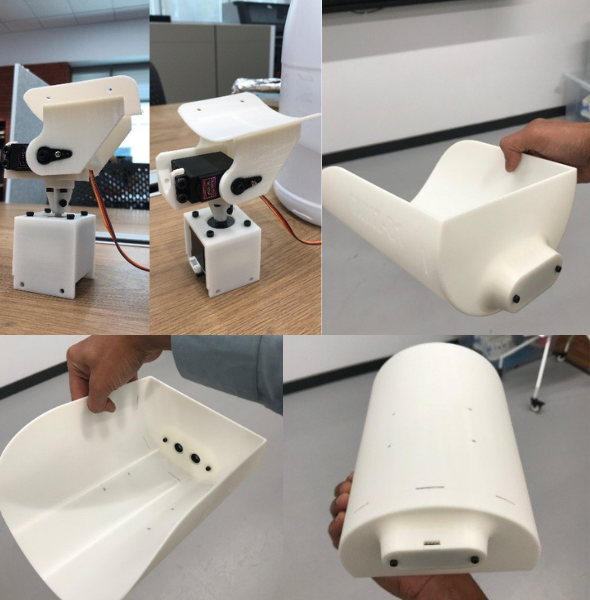
Developed under a tight deadline, this project involved the design and fabrication of a custom-sized bucket and stepper motor bracket for a unique garbage sorting application. The bucket was designed to hold objects while an ultrasonic sensor mounted at the rear detects whether it is full or empty.
The entire assembly was designed from scratch in SOLIDWORKS based on reference images and client-provided dimensions, and 3D printed in white PLA+ using a Prusa MK4. Despite being additively manufactured, the components achieved an exceptional surface finish—one of DLAB’s key strengths.
Engineering prototypes and functional mechanisms
Prosthetic Leg Prototype
This prosthetic leg prototype was designed and 3D printed at AUBH-DLAB for a school project aimed at simulating the knee joint motion of a human leg. The model was developed using SOLIDWORKS and fabricated using PLA+ to reduce prototyping costs. All components were produced using Bambu Lab A1 and X1 Carbon (X1C) 3D printers.
FARZ AI-Powered Automatic Garbage Sorting Machine – Stepper Motor Bracket and Bucket
Developed under a tight deadline, this project involved the design and fabrication of a custom-sized bucket and stepper motor bracket for a unique garbage sorting application. The bucket was designed to hold objects while an ultrasonic sensor mounted at the rear detects whether it is full or empty.
The entire assembly was designed from scratch in SOLIDWORKS based on reference images and client-provided dimensions, and 3D printed in white PLA+ using a Prusa MK4. Despite being additively manufactured, the components achieved an exceptional surface finish—one of DLAB’s key strengths.
Capstone project models and proof-of-concept builds
Lost PLA Casting Joints for an Architectural Sculpture (Proof of Concept)
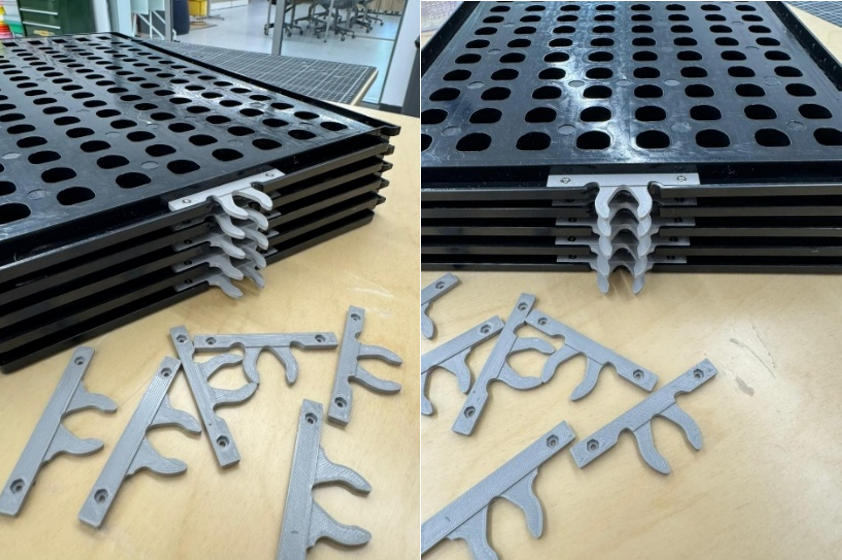
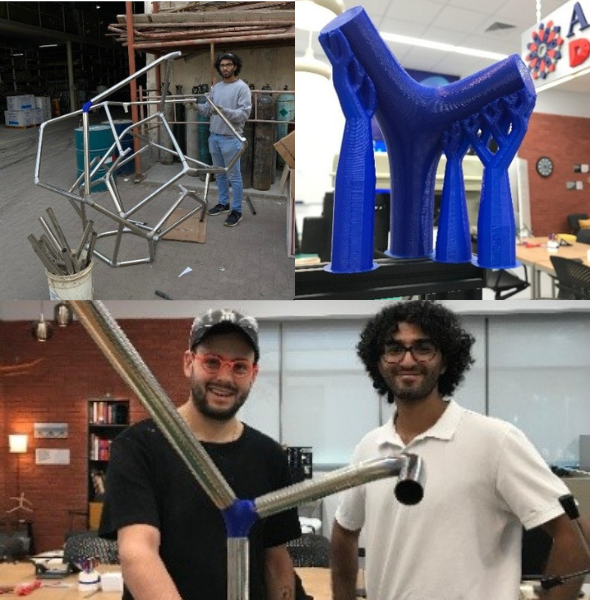
Corner joints for a metal architectural structure were first 3D printed in white and blue PLA using Ultimaker S3 and Ultimaker 2+ FDM printers. These printed parts were then converted into aluminum components using the lost PLA aluminum sand casting process, demonstrating a successful proof of concept for hybrid digital manufacturing.
Capstone project models and proof-of-concept builds
Lost PLA Casting Joints for an Architectural Sculpture (Proof of Concept)
Corner joints for a metal architectural structure were first 3D printed in white and blue PLA using Ultimaker S3 and Ultimaker 2+ FDM printers. These printed parts were then converted into aluminum components using the lost PLA aluminum sand casting process, demonstrating a successful proof of concept for hybrid digital manufacturing.
Product design and ergonomic studies
Fluidic Trophy Design
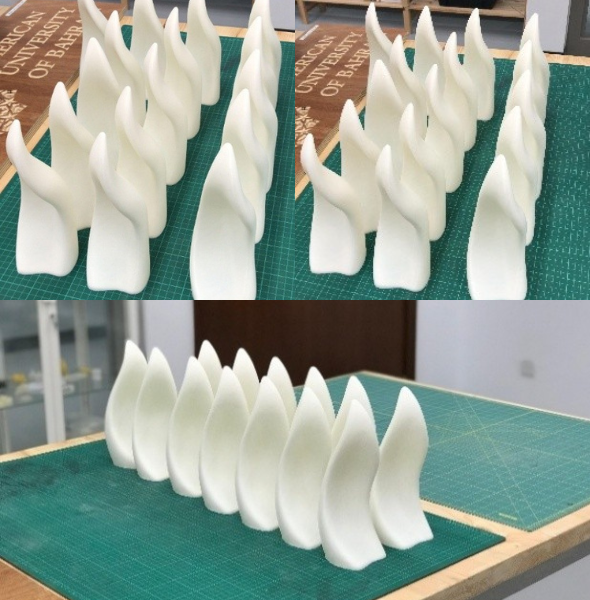
As part of an annual competition, an event management company collaborated with AUBH-DLAB to design and 3D print fluid-inspired trophies. The project highlights the lab’s capability in producing visually complex and ergonomically refined product designs.
3D Printed Sunglasses – Design & Prototyping
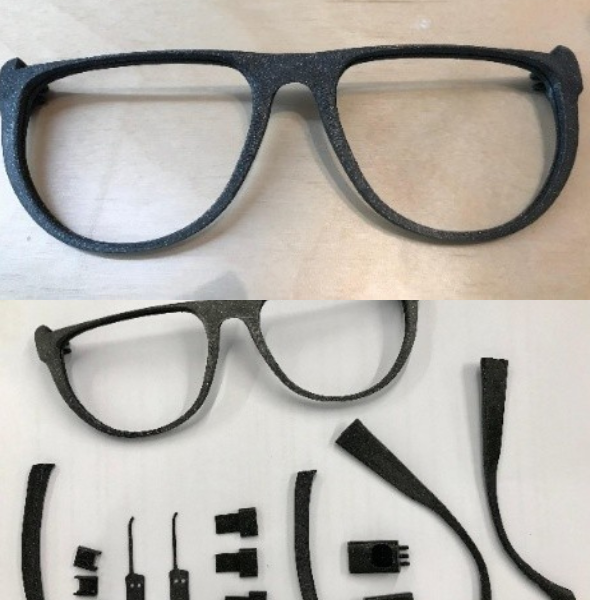
A Dubai-based eyewear design and manufacturing company partnered with AUBH-DLAB to develop a proof-of-concept prototype for the first iteration of a sunglasses design. All required components for the complete assembly were 3D printed using Prusa Galaxy Black filament on a Prusa MK4 and shipped to the client for evaluation.
3D Printed Sunglasses – Design & Prototyping
A Dubai-based eyewear design and manufacturing company partnered with AUBH-DLAB to develop a proof-of-concept prototype for the first iteration of a sunglasses design. All required components for the complete assembly were 3D printed using Prusa Galaxy Black filament on a Prusa MK4 and shipped to the client for evaluation.
Architectural and spatial models
Architectural Miniatures
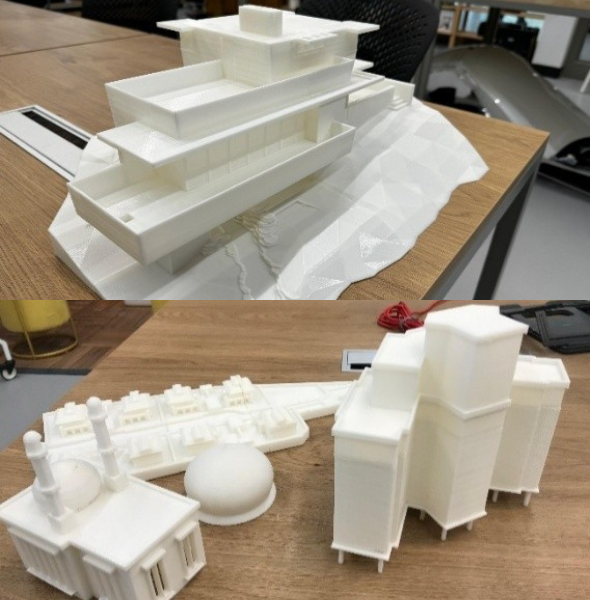
A selection of miniature building models designed by architecture students and professionals for final-year presentations. These models were produced at AUBH-DLAB using PLA+ filament to ensure cost-effective prototyping and were 3D printed using Bambu Lab A1 and X1 Carbon (X1C) printers.
Customized tools, fixtures, and experimental components
Reverse Engineering of an Aluminium Mold
A large aluminium mold (2 m × 1 m) used by a major Gulf-region aluminium ingot supplier was 3D scanned and converted into a dimensionally accurate CAD model. This project highlights DLAB’s expertise in large-scale reverse engineering and precision CAD reconstruction.
Customized tools, fixtures, and experimental components
Reverse Engineering of an Aluminium Mold
A large aluminium mold (2 m × 1 m) used by a major Gulf-region aluminium ingot supplier was 3D scanned and converted into a dimensionally accurate CAD model. This project highlights DLAB’s expertise in large-scale reverse engineering and precision CAD reconstruction.
Student-led innovation and competition entries
Student-Led Innovation and Competition Support
AUBH students actively participate in a wide range of national and international university-level competitions and have achieved notable success. Many of these competitions require fully functional physical prototypes. Students engage with AUBH-DLAB to access expert guidance, technical knowledge, design support, and 3D printing services to bring their ideas to life.
While AUBH-DLAB provides design, prototyping, and fabrication expertise, Project Space offers a safe and well-equipped environment with the necessary tools and components, enabling students to efficiently build, test, and refine their competition projects.
Each project reflects the lab’s emphasis on applied learning, iterative design, and hands-on problem solving.
External Use of the DLAB
In addition to supporting AUBH academic activities, the DLAB is also accessible to external users, including individuals, startups, schools, and organizations, subject to availability and approval.
All external use is managed through defined procedures to ensure alignment with AUBH policies, safety standards, and intellectual property guidelines. External engagement supports knowledge exchange, industry collaboration, and the broader innovation ecosystem.
Training & Technical Support
DLAB provides structured training and technical support to ensure users can safely and effectively utilize lab equipment. Training modules may include:
- Product design and prototyping workflows
- Manufacturing processes and materials
- Measurement and reverse engineering
- Digital fabrication techniques
- Microcontrollers and basic IoT applications
Training may be delivered as part of academic courses, supplementary learning activities, or open workshops, depending on program requirements.
How to use
Location & Access
DLAB is located on the American University of Bahrain campus and operates in coordination with academic schedules and approved project requirements. Access is provided to registered students, faculty, and authorized external users.
Step 1 – Request
Submit your service request through the system:
- Open the link or scan the QR code
- Select the service or book a consultation slot
- Choose the project type
- Select the consultant
- Submit your request
Step 2 – Review & Approval
- Review by the DLAB team
- Approval from DLAB and/or the University, depending on the project type
- Confirmation of budget, materials, and items</strong</;i>
Step 3 – Production
- Design and shaping of ideas
- Brainstorming and concept development
- Production and testing phase at the DLAB